The Early Movers Won Search. It's Happening Again.
Nearly half of what people type into ChatGPT is now the kind of question they used to type into Google.
Not essays. Not code. Questions. Where should I go? What should I buy? Who should I trust?
That is search. It just moved. And if you were in business in the early 2000s, you have seen this moment before: the quiet window when a new front door opens and almost nobody is standing in it yet.

What the data says
OpenAI's latest usage data shows search is now ChatGPT's center of gravity, and it's personal, not professional.
In OpenAI's original study of 1.5 million conversations, three-quarters of use was practical guidance, seeking information and writing. About half of all messages were people asking, using ChatGPT as an advisor.
The newest dataset, OpenAI Signals v3.0 (27 million sampled messages, 159 countries, July 2024–September 2026), as broken down by Kevin Indig of Growth Memo:
- 48% of messages are Google-style questions, up from 43% in July 2024, peaking at 51.4% in April 2026.
- That 48% splits into 20% simple searches (facts, products, recipes) and 28% practical guidance (how-to, health, creative ideas).
- Personal use grew to 68% of all messages, up from 48%. Within personal messages, Google-style questions run about 53%.
- Product and price research at work is rising. Among US work messages, asking about goods or services went from 1.7% to 2.9%; asking about prices more than doubled, 0.3% to 0.7%.
- Heavier-use countries search more. The top quarter of countries by usage put 24% of messages into simple searches, versus 16% for the lowest.

Read that last point twice. As usage grows, people don't use AI less for search. They use it more.
And the audience is not niche: ChatGPT passed 900 million weekly users in early 2026.

What Claude's data shows
ChatGPT is becoming the consumer's search engine. Claude is becoming the professional's workbench.
Anthropic tracks Claude use through its Economic Index, built on two million conversations split between everyday users and businesses. The picture is work-heavy, led by software development.
But the pattern underneath matches. Anthropic's latest report found experienced users get far better results than newcomers.
Different platforms, same lesson: the people who start early pull ahead.
We've seen this movie
The businesses that showed up early in Google still own it, and the gap has only widened.
Ahrefs' 2025 ranking study put numbers on what every early adopter felt:
- The average #1 page on Google is 5 years old, up from 2 years in 2017.
- 72.9% of top-10 pages are more than 3 years old.
- Only 1.74% of new pages reach the top 10 within a year.
Search rewards tenure. The early movers didn't just rank first. They kept ranking, collecting links, reviews and trust that latecomers now pay for in years and dollars.
The small bakery that started a blog in 2006 still shows up for "best croissant near me." The competitor that waited until 2016 is still buying ads to stand beside it.

Why SEO is the on-ramp to AI
The signals that win Google feed AI answers, but AI casts a wider net, which is exactly why the door is open.
Google's own AI Overviews lean hard on rankings: 76% of the pages they cite already rank in Google's top 10 (Ahrefs).

Standalone assistants are different. When Ahrefs compared ChatGPT, Perplexity and others with Google's results, only about 12% of their cited pages ranked in the top 10 for the same question (Ahrefs).
Read together: ranking still matters, but it isn't the only way in. AI assistants pull from the wider web: the specific answer, the detailed review, the local mention. A small business doesn't have to outrank a national brand on Google to be the name ChatGPT recommends. It has to be the clearest answer.
That's the opening. And openings close.
Why the window is open for small businesses right now
AI answers are still deciding who to trust. That window won't stay open.
Google gave you ten blue links. ChatGPT gives one answer, maybe three names. There is no page two. You are either in the answer or you are not in the conversation.

The data says the questions that matter most to small businesses are the ones growing fastest: personal, local, practical. Which med spa. Which contractor. Which yoga studio is worth it. And people are increasingly asking AI to compare products and prices before they ever reach a website.
Right now, most small businesses are invisible here. Not because they lost, but because they haven't played. The big brands are still debating budgets. The field is unusually level.
It won't stay that way. The longer AI models keep reading, citing and recommending the same names, the harder those names are to dislodge. Just like Google.
"But AI sends fewer clicks." True, and it matters less than you think. When AI recommends you, the click that does come is pre-sold. The customer has already been told you're the answer. Visibility is the new traffic.

Your next steps: how small businesses turn this into an advantage
AI recommends what it can read, verify and repeat, so give it all three.
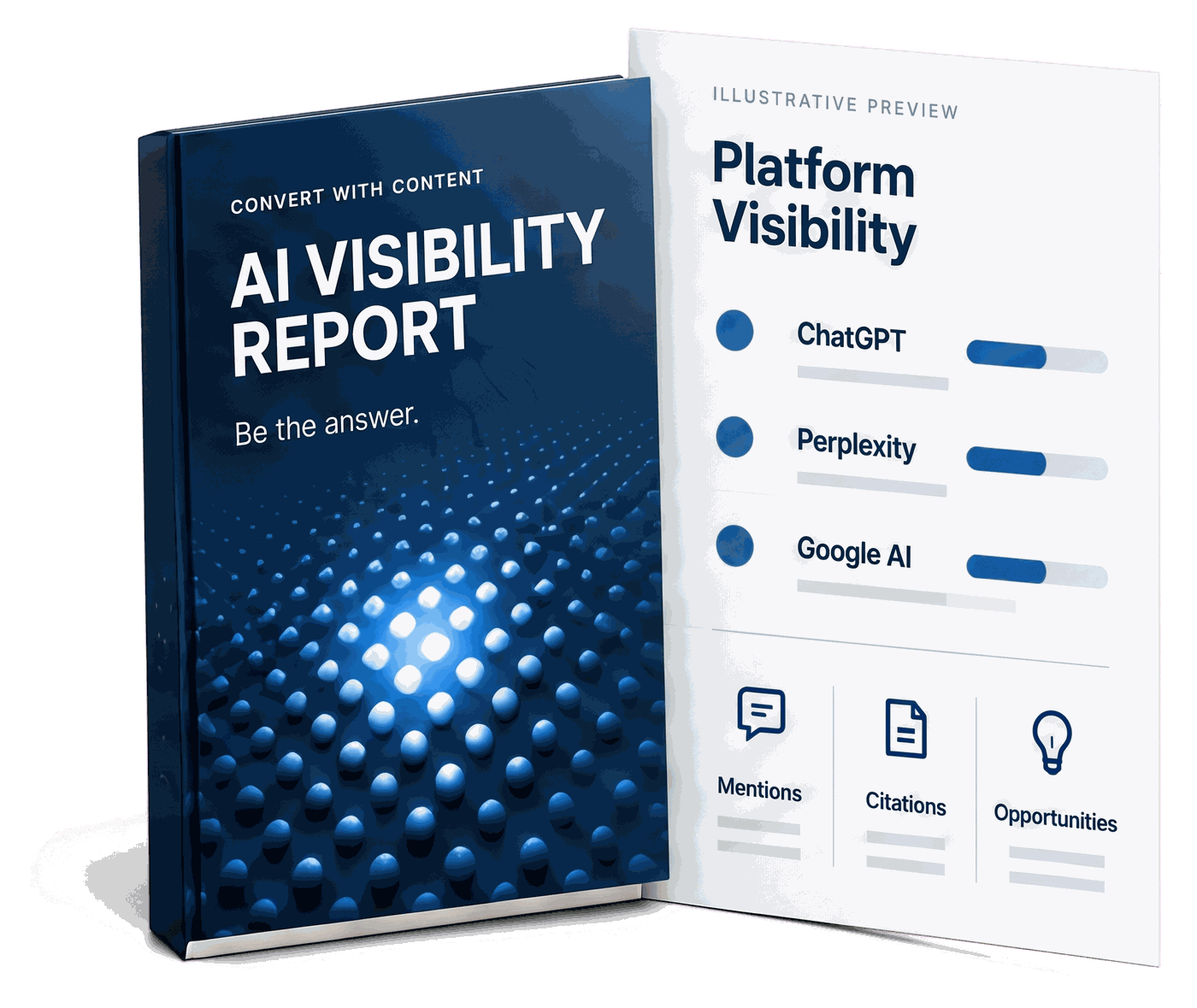
- Get your AI Visibility Report. Before you change anything, find out where you stand. Which questions surface your business in ChatGPT, Gemini and Claude? Which surface your competitors? Where are you missing entirely? This is your baseline and your map.
- Remember: content is still king. Knowing what people ask is the advantage. Write every page as if you're answering a real question, because you are. Then match the format to the question:
- How-to guides for practical guidance: "How to prepare for your first sound bath"
- Product and service reviews for buyers comparing options: "Best facials for sensitive skin"
- Comparisons and pricing pages for the rising product and price research: "Membership vs. drop-in: what's worth it"
- FAQs for the quick, simple searches: direct question, direct answer
- Become the name others repeat. AI trusts what others say about you more than what you say about yourself. Earn mentions in local press, podcasts, partner sites and community roundups. Keep your name, services and story identical on your site, Google Business Profile and directories.
- Collect reviews that say something. Detail beats stars. "Best facial for sensitive skin in Coronado" is a sentence an AI can reuse.
- Put a face on it. A founder with a visible point of view (on LinkedIn, in a column, on your site) gives AI a person to recommend, not just a business.
- Measure, then repeat. Rerun your visibility check every month. Watch which questions you've won and which you haven't, and write toward the gap.
None of this is new. It's good SEO with a sharper edge. The difference is the clock.
The front door just moved
The businesses that win the next decade of search will be the ones that showed up this year.
Twenty years ago, the early movers didn't know Google would become the front door. They just walked through it first.
You don't have to guess this time. The data is right there.
Ready to find out where you stand? Get your free AI Visibility Report →
FAQ
Is SEO dead? No. It's the foundation. Google's AI Overviews cite top-ranking pages most, and the habits that build rankings (clear answers, real reviews, consistent listings) are what AI assistants read too.
How do I know if AI recommends my business? Ask it. Type the questions your customers ask into ChatGPT, Gemini and Claude, and note who shows up. An AI Visibility Report does this across dozens of questions at once.
Is it too late to start? No, and that's the point. Most small businesses haven't started. The advantage goes to whoever builds authority before the answers settle.
What kind of content does AI recommend? Content that answers a specific question directly: how-to guides, honest reviews, comparisons, pricing pages and FAQs.
Sources
- How people are using ChatGPT (OpenAI)
- OpenAI Signals v3.0, "ChatGPT's expanding world of work," via Kevin Indig, Growth Memo
- How Long Does It Take to Rank in Google? (Ahrefs)
- 76% of AI Overview Citations Pull From the Top 10 (Ahrefs)
- Only 12% of AI Cited URLs Rank in Google's Top 10 (Ahrefs)
- ChatGPT statistics (Search Engine Land)
- Anthropic Economic Index: New building blocks for understanding AI use (Anthropic)
- Anthropic Economic Index, January 2026 report (Anthropic)
- Anthropic Economic Index, April 2026 (Built In)
Get your free AI Visibility Report