AI Content Writing Done Right: Why Every Piece Still Gets the Human Touch

The marketing landscape looks a lot different today than it did even a few years ago. Content marketing is still the engine, but artificial intelligence has changed how fast that engine can run. Today, AI is making waves, promising faster content production and automated tasks, and more businesses are trying it every month.
So there's an important question to ask: is AI ready to write your marketing? Or perhaps the better question is, what does it take to make AI content actually good?
The AI Appeal: Speed and Numbers
Let's first talk about AI as a content creation tool.
AI's allure lies in its efficiency and speed. It can handle research, outlines, first drafts and repetitive tasks in minutes instead of days. It helps creators get past writer's block and turn out far more content than a small team ever could on its own.
But here's the thing. Speed alone doesn't rank, and it doesn't convert. Type one prompt into ChatGPT, copy the answer, hit publish, and you'll usually get something that reads fine and says very little. That's not a problem with AI. It's a problem with how most people use it.
It's absolutely essential that a human being edit and review every single piece of content before it goes on a blog or any other web platform. When you build the process around that rule, AI becomes a serious advantage.
Let's look at where one-prompt AI content goes wrong, and how a proper system fixes each one...
Where One-Prompt AI Content Misses the Mark
AI on its own is very good at what we'll call "content scaffolding": the overall framework of a blog post, an article or a webpage. Where unmanaged AI content falls short is the stuff search engines value and readers crave. Here's what we see most often.
Missing the Emotional Connection
A single prompt doesn't know your customers. Without direction, AI writes for "everyone," which means it really writes for no one. The result is dry, information-driven content that doesn't capture a reader's attention or leave a lasting impression.
The fix: give the AI your voice before it writes a word. We build a brand voice profile for every customer during onboarding, and every writer and editor works from it. Then a human editor reads every piece for the thing a prompt can't check for: does this actually sound like you, and will your reader care?
Missing the Context and Audience Needs
One thing that makes content great, whether it's a blog, a reel or a podcast, is that it knows the target audience intimately.
Generic AI output skips the nuances of context: who's reading, what they already know, what question brought them here. That leads to pieces that miss the mark with the people you're trying to reach, and fail to generate engagement or conversions.
The fix: research comes first. Before anything gets drafted, a research step looks at what your buyers are actually asking and what's already ranking. The brief that comes out of it tells the writer exactly who the piece is for.
The Potential for Factual Inaccuracy
Experienced content creators know how to check facts, and factual accuracy is a vital key to credible content. AI doesn't "know" facts. It predicts words. Even with good prompt writing, you can't assume AI content is 100% accurate.
If a mistake slips through, it hurts your site's credibility with readers and search engines alike, which is the opposite of what you're trying to achieve.
The fix: checkpoints. A dedicated editing and QA step reviews every draft, and then a human editor signs off before anything is published. Nothing goes live on autopilot.
Generic Content That Doesn't Rank
Ask ChatGPT, Gemini or Claude for "an exciting blog post" and you'll often get the same generic output everyone else is getting. Instead of making you stand out, your piece fades into the background and drowns in a sea of similar content.
The fix: playbooks and a learning loop. Each step in the process follows its own written playbook, tuned to your business, so the output reflects your offers, your examples and your point of view. And when you give feedback, it goes to the human editor and gets written back into those playbooks, so every round comes out sharper than the last.
How We Do It at Convert With Content
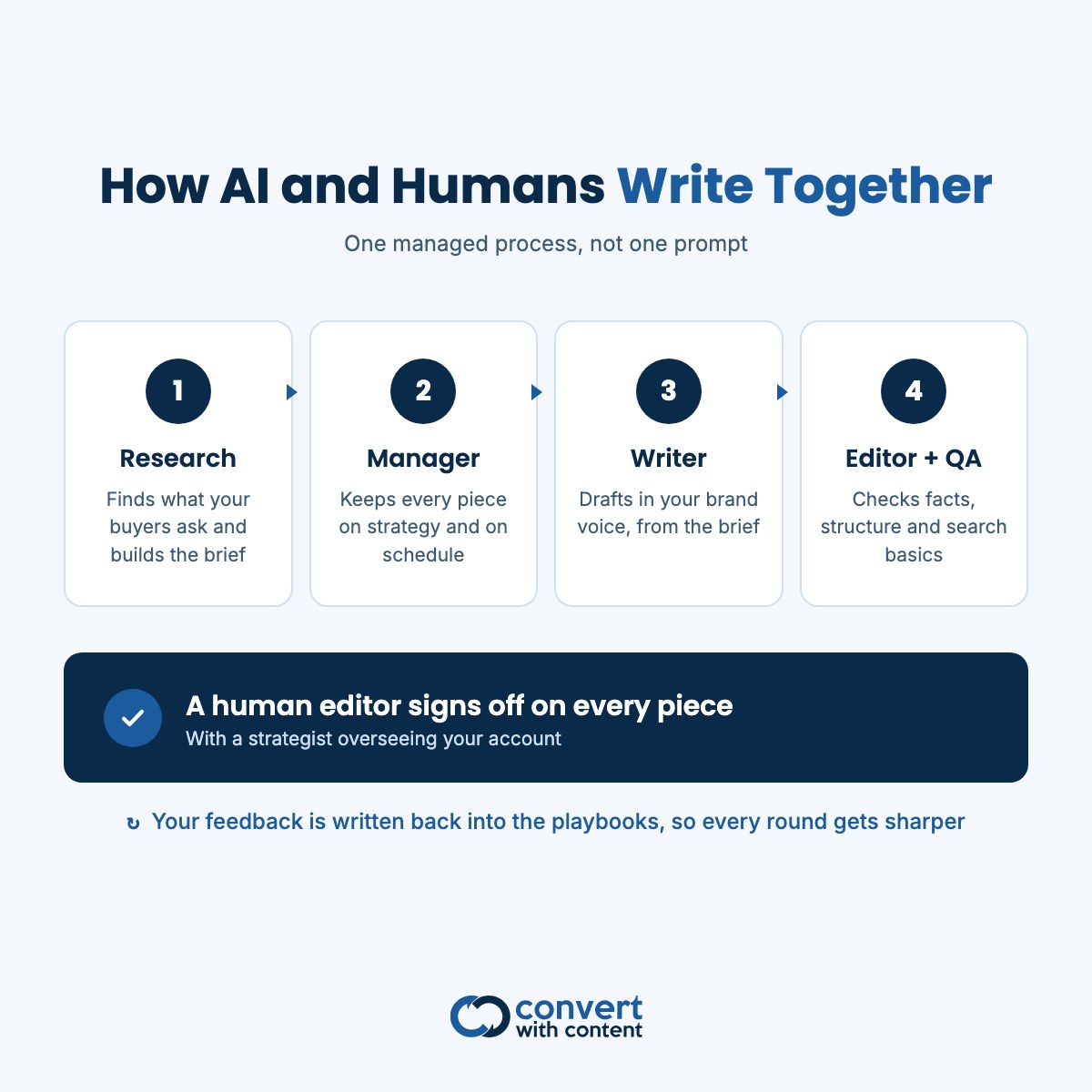
Here at Convert With Content, this is exactly how our AI Content Production works. Instead of one prompt, every piece moves through a custom content hub of four specialist AI agents, each running on its own playbook:
- Research: finds the questions your buyers are asking and what's already out there, then builds the brief.
- Manager: keeps each piece on strategy and on schedule, and moves it through the checkpoints.
- Writer: drafts in your brand voice, from the brief.
- Editor + QA: tightens the draft and checks facts, structure and search basics.
Then a human editor reviews and signs off on every piece, with a strategist overseeing your account. That's the human touch, built into the process instead of bolted on at the end.
Wrapping It Up
At the end of the day, remember this: AI is incredibly powerful for content, but only when it's managed well. The human touch still matters. It just shows up in a different place. Humans set the strategy, define the voice, check the facts and make the final call. AI does the heavy lifting in between.
Do it that way, and you get what everyone wanted from AI in the first place: more content, published faster, that actually sounds like you and actually ranks.
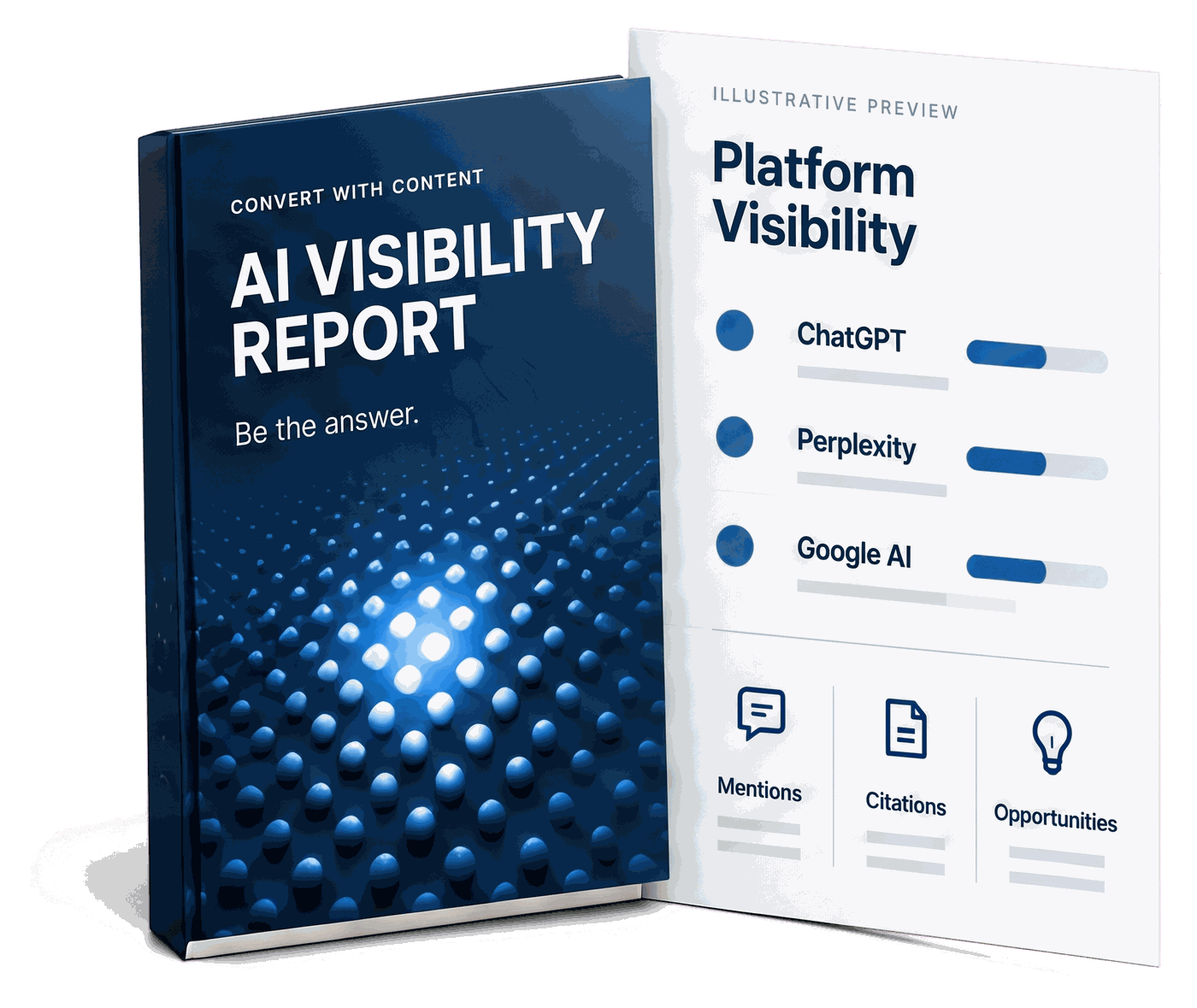
Want to see where your business shows up in AI answers? Get your free AI Visibility Report, and we'll show you where you appear, which pages get cited and what to fix first.
Get your free AI Visibility Report